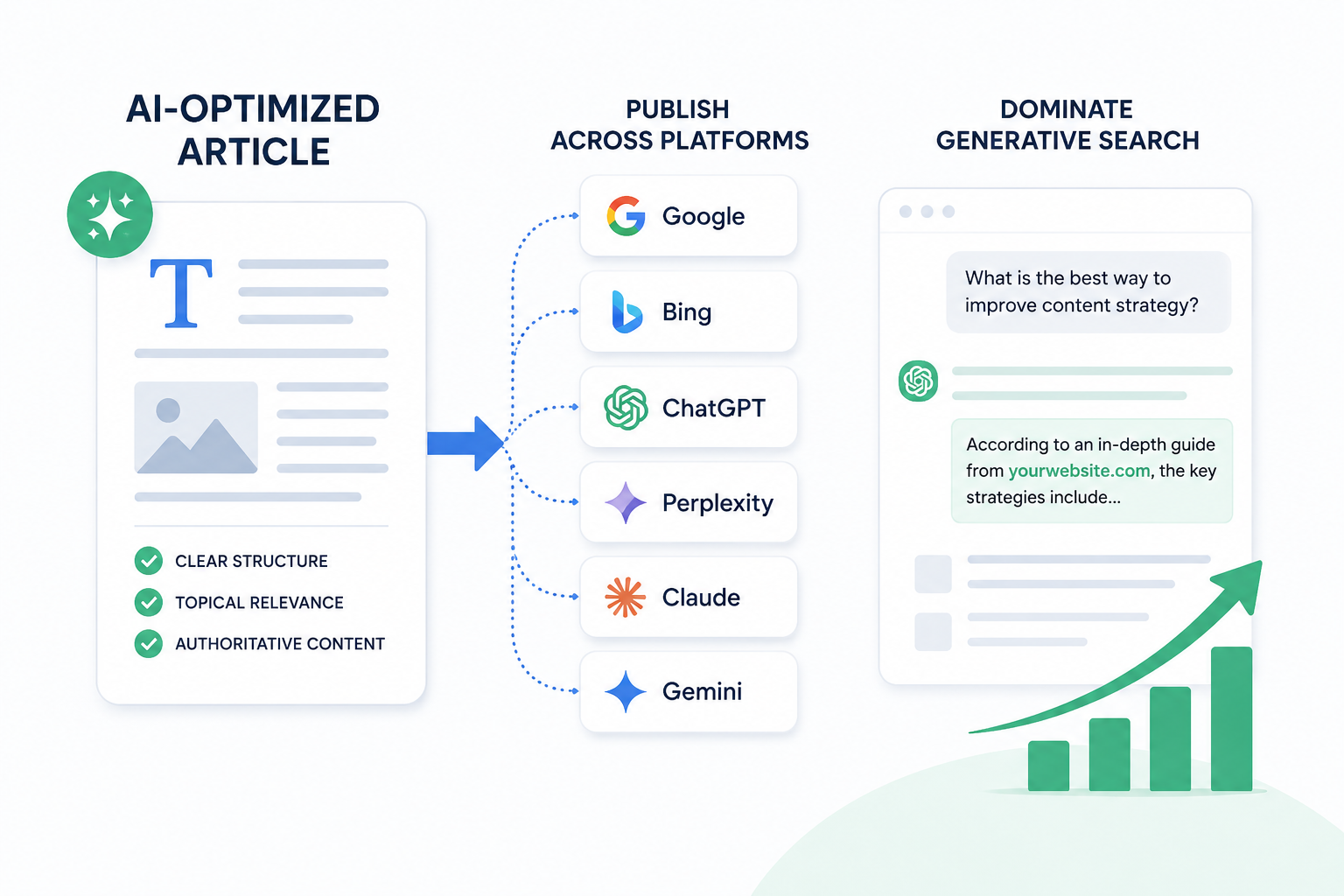
You want your content to show up in AI search results. Not just once in a while, but consistently across ChatGPT, Claude, Perplexity, and whatever comes next. The old SEO playbook won’t get you there. Here’s what works now.
Why Generative Search Needs a Different Approach
Traditional search engines rank web pages. Generative AI models rank ideas. They pull from multiple sources, synthesize answers, and cite the content that actually answers the question. You can’t just stuff keywords and expect to win.
The shift is clear. AI search tools don’t crawl the web the same way Google does. They look for structured, authoritative, and well-formatted information they can easily digest and reference. Your content has to serve both humans and machines at the same time.
Building Articles That AI Models Trust
Start with structure. AI models latch onto clear hierarchies. Use H2 and H3 headings that directly address what someone might ask. Make every section self-contained so an AI can pull a complete answer without scanning the entire page.
Get to the point fast. Lead with the answer, then explain. AI tools extract information from the top of articles more than the bottom. If you bury your key insight three paragraphs deep, you miss the opportunity.
Back up claims with specifics. AI models favor content that cites studies, uses real numbers, and references credible sources. Blanket statements without evidence get ignored. Concrete details get cited.
Publishing Across the Right Platforms
Your website remains the anchor, but don’t stop there. AI models pull data from multiple sources. You need your content in those places.
Medium and LinkedIn Articles index well in generative search because the platforms carry domain authority AI tools already trust. Publish your long-form content there as companion pieces, linking back to your main site.
Developer documentation platforms like GitHub and Dev.to carry weight for technical content. Answering specific questions on Stack Overflow or Quora creates indexing points for niche queries.
The key is consistency. Same article, adapted slightly for each platform’s audience and format, but keeping the core structure intact. AI models cross-reference these versions and recognize the consistency as a trust signal.
Format Optimization That Moves the Needle
Bulleted lists and numbered steps outperform dense paragraphs. AI models extract structured data more reliably from formatted lists. When you make a point, consider whether it belongs in a list.
Short sentences work better for extraction. AI tools parse declarative statements cleanly. Meandering sentences with multiple clauses confuse the extraction process and lower your chance of being quoted directly.
Define terms early. If you’re covering a complex topic, include a clear definition in the first or second paragraph. AI models use these definitions to understand context and match your content to relevant queries.
Metadata Still Matters, Just Differently
Title tags and meta descriptions influence what AI tools display as context around your citation. Write them as complete thoughts, not keyword strings. An AI tool might use your meta description verbatim as the snippet it shows users.
Schema markup helps AI understand your content’s purpose. Implement FAQ, HowTo, and Article schema where relevant. This structured data feeds directly into how AI models categorize and retrieve your information.
Alt text on images carries weight too. AI tools that process multimodal inputs reference image descriptions when building responses. Describe what’s in the image clearly and factually.
The Distribution Loop That Builds Authority
Publish on your site first. Wait a few days for indexing. Then push variations to your secondary platforms. This creates a trail of consistent information that AI models recognize over time.
Update content on a schedule. AI models favor freshness. A stale article from three years ago loses ground to a recently updated piece with new data, even if the core message is the same.
Cross-link between your platforms. When your Medium article references your website post, and your LinkedIn summary points to both, you create a web of interconnectivity that AI models trust as a signal of authority.
Metrics That Actually Tell You Something
Page views mean less in generative search. Track how often AI platforms cite your domain. Tools are emerging for this, but for now, manual spot checks on ChatGPT and Perplexity will show you if your content appears.
Conversions from AI-driven traffic tend to come from highly specific, bottom-of-funnel queries. Monitor your analytics for traffic patterns that show users arriving with clear intent and a deep understanding of the topic already in place.
Common Mistakes to Fix Right Now
Stop writing introductions that set the stage for too long. AI models scan the first 100 words for the core answer. Give it to them.
Quit optimizing for a single keyword. Generative search processes entire semantic fields. Cover the topic completely rather than hammering one phrase repeatedly.
Don’t ignore your author bio. AI tools factor author expertise into citation decisions. A bio that shows real credentials, experience, or a track record on the subject moves the needle.
Focus on factual accuracy. AI models cross-check claims within seconds. An error that slips through can cause your entire piece to be ignored by multiple platforms at once.
You build visibility in generative search by writing clear, structured content and releasing it into the ecosystems where AI models look for answers. This is the new distribution playbook. Your articles reach further and your citations compound over time when you commit to this process.