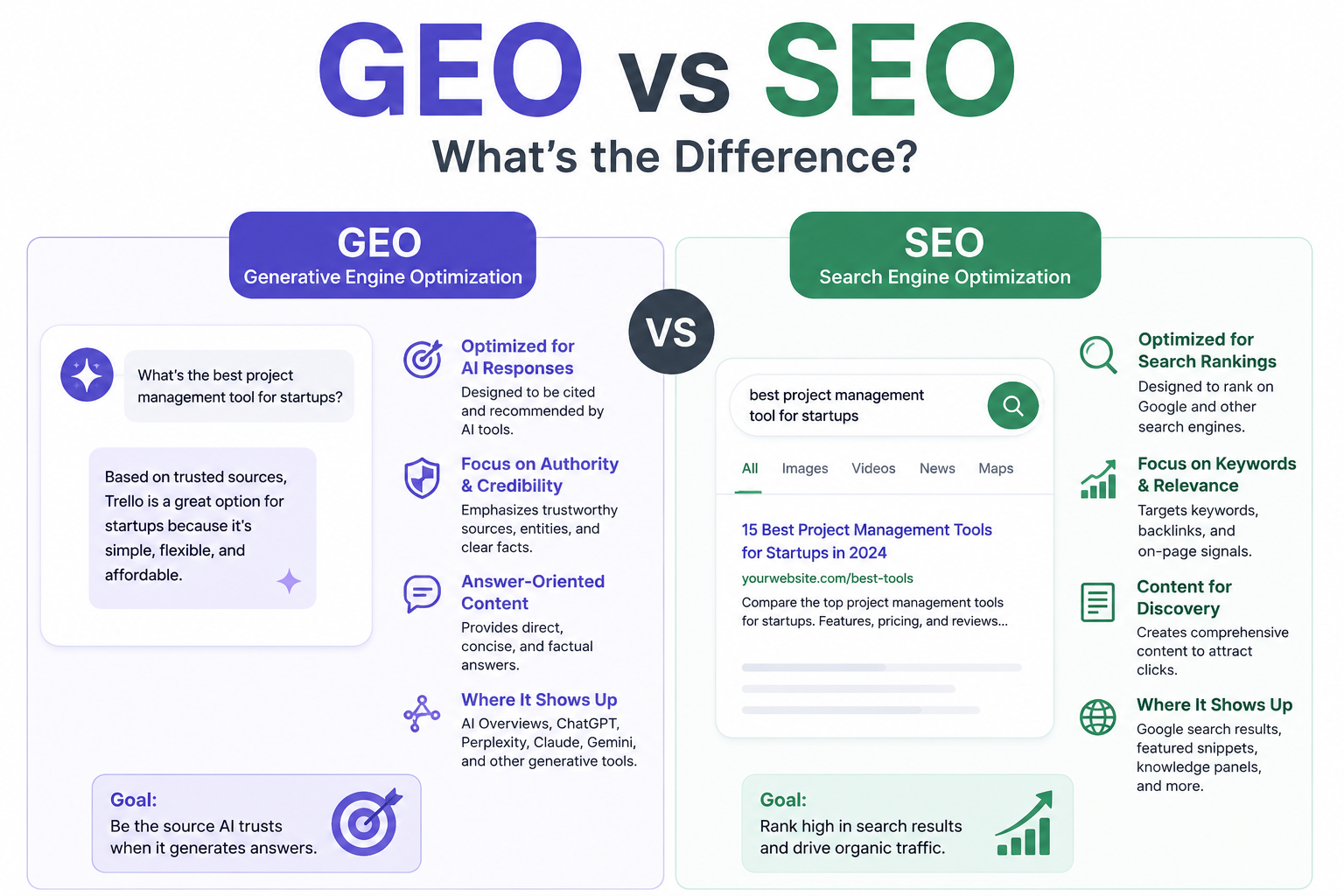
Search changes fast. You optimized your website for Google five years ago. That playbook fails today. Now you face a new challenge: Generative Engine Optimization.
Stop thinking about keywords. Start thinking about answers. Traditional SEO targets search engines. GEO targets AI models like ChatGPT, Claude, and Perplexity. Both matter. You need to understand the split.
What SEO Actually Does
SEO pushes your content to the top of search engine results pages. You target keywords. You build backlinks. You optimize meta tags. The goal: appear in the blue links.
Google’s algorithm ranks pages based on hundreds of signals. You fight for position zero—the featured snippet. You structure data so crawlers understand your content. This game continues. 53% of website traffic still comes from organic search.
But the model cracks. Users ask questions in natural language. Google answers directly on the results page. Traffic leaks away. Zero-click searches hit 25% of all queries. Your carefully optimized page never gets the visit.
What GEO Adds to the Equation
GEO makes your content visible inside AI-generated answers. ChatGPT, Claude, Perplexity, and Google’s AI Overviews scrape, synthesize, and cite sources. They don’t rank pages. They build responses from multiple sources.
Your content needs to become the source the AI trusts and cites. This changes everything.
GEO focuses on:
- Answering specific questions with tight, accurate paragraphs
- Using clear source attribution and factual claims
- Structuring information for extraction, not just reading
- Building topical authority across connected subjects
- Getting cited in training data and real-time queries
The AI reads your page. It decides if your answer fits the user’s intent. No click required. Either you’re in the response or you’re invisible.
Core Differences Between GEO and SEO
| Factor | SEO | GEO |
|---|---|---|
| Primary target | Search engine crawlers | AI models and answer engines |
| Success metric | Rankings and organic traffic | Citations and visibility in AI answers |
| Content structure | Optimized for scanning | Optimized for synthesis |
| Keyword strategy | Match user queries exactly | Cover topics comprehensively |
| Authority signal | Backlinks and domain rating | Citations and source reliability |
| User interaction | Click to website | Answer consumed in-platform |
| Technical focus | Page speed, schema, mobile | Clear structure, factual accuracy |
The skills overlap but diverge fast. SEO optimizes for discovery. GEO optimizes for selection and citation.
Why Both Matter Now
You can’t abandon SEO. Traditional search still drives traffic. But AI search grows daily. ChatGPT passes 200 million weekly active users. Perplexity handles millions of queries. Google integrates AI Overviews into standard results.
Your visibility splits across two systems. A strong SEO foundation helps GEO because well-structured, accurate content ranks well everywhere. But GEO demands more.
Write for the answer, not just the result page.
How to Optimize for GEO
Shift your approach:
1. Answer complete questions in 50-80 words
AI models extract concise answers. Place the direct answer at the top of your content. Follow with supporting detail. Cut fluff.
2. Cite original sources and data
AI models trust content that references verifiable information. Link to studies. Mention statistics with dates. Attribution builds authority.
3. Structure content with clear headings and sections
AI scrapers parse semantic HTML. Use descriptive H2s and H3s. Break text into logical chunks. Tables help. Lists help. Long blocks of text get ignored.
4. Build topic clusters, not just keyword pages
Cover a subject from multiple angles. AI models favor sources that demonstrate comprehensive knowledge. Publish series. Create hub pages. Link internally with purpose.
5. Maintain factual precision
AI models penalize vague claims. State exactly what the data shows. If you don’t know, don’t guess. Correction and updates signal reliability.
Common Mistakes
You optimize for bots and forget humans. That fails in both worlds. AI models prioritize content that human readers find useful. Thin content designed only for keywords fails harder now.
You stuff keywords. AI systems understand context. Keyword stuffing looks unnatural. Write naturally about the topic.
You ignore formatting. Walls of text repel AI scrapers. Use white space. Use short paragraphs. Make your content scannable for machines and people.
Where GEO Fails Without SEO
You publish great content but nobody sees it. SEO builds the distribution layer. Backlinks still signal trust. Social shares still amplify reach. Technical health still matters. AI models crawl the web. Broken sites get skipped.
GEO extends your strategy. It doesn’t replace it.
Measuring GEO Performance
Track different metrics:
- Citations in AI responses for target queries
- Brand mentions inside AI platforms
- Referral traffic from AI sources like Perplexity
- Visibility scores in AI-generated answers
- Conversion from AI-referred visitors
These numbers start small. They grow as AI search expands.
What Comes Next
Search fragments. AI platforms multiply. Your content appears in chat interfaces, voice assistants, and embedded answer boxes. The source matters more than the domain. Become the source.
Build content that answers questions directly. Make your brand the citation AI models return to. Monitor where your content appears in AI outputs. Adjust based on what gets cited.
FAQ
Do I need to change my entire SEO strategy for GEO?
No. You need to extend it. Keep your technical SEO solid. Add GEO principles to your content creation process. Write for extraction and citation, not just ranking.
How long before GEO impacts my traffic?
Already happening. If your content doesn’t appear in AI overviews or ChatGPT responses, you lose visibility to competitors who do. The shift accelerates through 2025.
Can small websites compete in GEO?
Yes. AI models cite accurate niche sources all the time. Focus on specific questions in your field. Provide clear, factual answers. Size matters less than precision.
What tools measure GEO performance?
Limited options exist today. Track brand mentions in AI platforms manually. Use citation monitoring tools as they develop. Watch referral traffic labeled as AI sources in analytics.
Does GEO work for e-commerce?
Yes. Product recommendations appear in AI responses. Detailed product pages with specs, comparisons, and honest descriptions get cited. Generic product pages get skipped.
How do I check if my content appears in AI answers?
Ask ChatGPT or Perplexity questions your content answers. Note whether you appear. Test regularly. Citations fluctuate.
Should I optimize for specific AI models differently?
Similar principles apply across models. Provide accurate, structured content. Specific model preferences for source selection remain proprietary.
Key Takeaways
- SEO targets search engine rankings. GEO targets AI answer citations.
- AI models cite sources that provide direct, accurate, well-structured answers.
- Write concise answer blocks. Support them with detailed content.
- Build topical authority. AI models favor comprehensive sources.
- Track citations and AI visibility. Standard ranking reports miss the full picture.
- Both strategies work together. SEO builds the foundation. GEO builds the presence inside AI platforms.