Introduction
AI models don’t rank pages. They pick sources. When ChatGPT or Perplexity builds an answer, it scans for the most authoritative, comprehensive source available on a given subject. Single pages rarely win that selection. Topic clusters do.
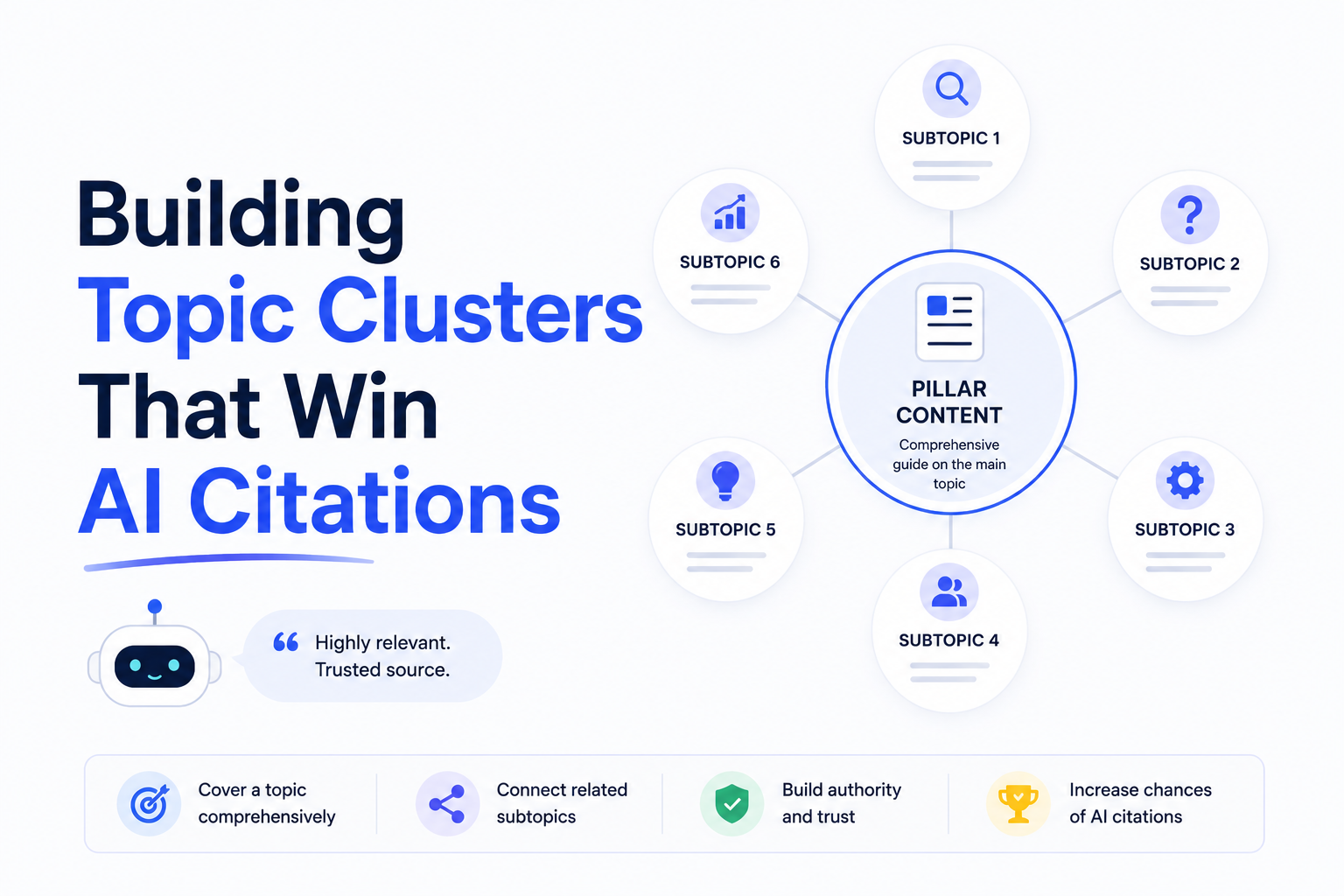
A topic cluster is a network of interlinked pages covering a subject from multiple angles—a central pillar page supported by cluster content that goes deep on subtopics. Search engines have rewarded this structure for years. But AI models now make it non-negotiable. Without clusters, your content looks shallow. With them, you signal mastery that AI models trust.
This article shows you how to build topic clusters specifically designed to win AI citations. Not just more content. Smarter content.
Why AI Models Favor Topic Clusters Over Standalone Pages
AI models like ChatGPT, Claude, and Perplexity operate differently from search engines. Google crawls your page and ranks it against others for a specific query. AI models crawl your entire site to understand what you know.
When an AI model sees a cluster, it recognizes three things:
- Depth. A pillar page with 10 supporting articles signals you covered the subject exhaustively.
- Connectedness. Internal links between cluster pages show the AI how concepts relate. It mirrors how the model itself organizes knowledge.
- Authority. Comprehensive coverage tells the model you’re a primary source, not a commentator.
Standalone pages leave the AI guessing. Did you go deep on this topic or just skim it? The model errs on the side of caution and cites the source that demonstrably knows more.
Think of it this way: you’re not optimizing for a search algorithm’s ranking factors anymore. You’re building a knowledge graph the AI can traverse and trust.
The Two-Layer Cluster Architecture
Every effective topic cluster has two layers.
The pillar page serves as your definitive resource on a broad topic. It answers the big question. It links to every piece of supporting content. It runs 2,000–4,000 words. It gets updated regularly.
The cluster content targets specific questions, use cases, or angles within the topic. Each piece links back to the pillar and to related cluster pages. These run 800–1,500 words. They’re tight, specific, and answer exactly one question well.
Here’s what a cluster looks like in practice for a topic like “generative engine optimization”:
| Layer | Page Type | Example Title |
|---|---|---|
| Pillar | Core resource | “Generative Engine Optimization: The Complete Guide” |
| Cluster | How-to | “How to Structure Content for AI Extraction” |
| Cluster | Comparison | “GEO vs Traditional SEO: Key Differences” |
| Cluster | Tool-focused | “Tools That Measure AI Citation Performance” |
| Cluster | Platform-specific | “Optimizing for Perplexity Citations” |
| Cluster | Case study | “How One SaaS Brand Increased AI Visibility by 40%” |
Every cluster page strengthens the pillar. The pillar gives context to every cluster page. Together, they create a resource AI models can’t ignore.
How to Choose Cluster Topics That AI Models Actually Cite
Random content won’t win citations. You need to build clusters around topics AI models actively pull into responses. Here’s how to find those topics.
Start with AI output analysis.
Ask ChatGPT, Perplexity, and Claude questions in your field. Note what gets cited. Look for patterns. Which topics trigger source-heavy responses? Which generate thin, unsourced answers? Target the gaps.
Mine “People Also Ask” boxes.
These questions represent exactly what users ask AI platforms. Each PAA question can become a cluster page. The box itself tells you the format AI models prefer—concise, direct, factual.
Analyze competitor citation patterns.
Search for your target queries on Perplexity. Note which competitors appear. Examine their site structure. Do they use clusters? Where are their gaps? Build what they missed.
Use query modifiers as cluster signals.
Queries containing “how,” “what is,” “vs,” “examples of,” and “step by step” indicate educational intent. AI models cite educational content heavily. Each modifier represents a cluster angle.
Prioritize topics with clear factual answers.
AI models avoid citing vague, opinion-based content. They gravitate toward content that states facts, provides data, and answers questions definitively. Choose cluster topics where you can be precise.
Internal Linking That AI Models Understand
Internal links do more than help users navigate. They tell AI crawlers how your knowledge connects. Bad linking buries your cluster. Strategic linking elevates it.
Link from the pillar down. Your pillar page should link to every cluster page. Use descriptive anchor text that matches the target page’s topic. Don’t use “click here.” Use “how to structure content for AI extraction.”
Link cluster pages laterally. When two cluster pages relate, link them. If you have pages on “GEO for e-commerce” and “GEO for SaaS,” cross-link them. The AI sees the connection and understands you cover the full landscape.
Link cluster pages back to the pillar. Every cluster page returns to the pillar. This creates a hub-and-spoke pattern AI models recognize as authoritative.
Use semantic anchor text. Your anchor text should preview exactly what the linked page contains. This helps AI models build an accurate map of your content relationships.
Here’s what the link architecture looks like:
- Pillar → All cluster pages
- Cluster page → Pillar page
- Cluster page → Related cluster pages (where relevant)
- Cluster page → External authoritative sources (for factual claims)
Avoid orphan pages. A cluster page with no internal links signals low importance. AI models treat orphan pages the same way search engines do—they ignore them.
Writing Cluster Content for Extraction, Not Just Reading
AI models extract content. They don’t browse. Your cluster pages need to be built for that extraction process.
Place the direct answer first. Open each page with a 50–80 word answer to the core question. No introduction. No preamble. The AI scrapes the opening paragraph and uses it as the response. Make that paragraph count.
Use question-based headings. Your H2s and H3s should mirror real user questions. “What metrics track AI citation performance?” beats “Citation Metrics.” The AI matches headings to query intent directly.
Break content into extractable blocks. Use short paragraphs (2–3 sentences). Use bullet lists. Use tables. AI models parse structured content faster than dense prose.
Include source citations within your content. When you state a statistic, link to the original study. When you make a claim, reference where it came from. AI models trust content that demonstrates sourcing discipline. They’re more likely to cite a source that cites others.
Close each page with a summary block. A 2–3 sentence recap at the bottom reinforces the core answer. Some AI models extract closing summaries as their primary citation.
The structure matters as much as the substance. Write for the machine’s extraction logic while keeping the human reader engaged. Both win when you do.
Common Cluster Mistakes That Kill AI Citations
Many clusters fail not because the content is bad, but because the structure undermines AI trust.
Thin cluster pages. A 300-word page doesn’t demonstrate depth. AI models skip thin content. Every cluster page should fully answer its target question with supporting detail, examples, and data.
Missing internal links. You built 12 pages but linked only three. The AI sees isolated fragments, not a connected knowledge base. Link everything.
Overlapping content across cluster pages. When two pages answer the same question differently, the AI gets confused. Confusion kills citations. Each cluster page needs a distinct, non-overlapping focus.
Neglecting updates. AI models favor fresh content. A cluster published two years ago with no updates signals abandonment. Update pillar pages quarterly. Refresh cluster pages when data changes.
Ignoring factual precision. Vague statements like “many companies see results” fail. AI models want specifics: “Companies using topic clusters report 40% higher citation rates in Perplexity responses.” Precision builds trust.
No external citations. Pages that never link to outside sources appear isolated from the broader knowledge ecosystem. AI models interpret this as unreliability. Link to reputable external sources where relevant.
FAQ
How many cluster pages does a topic need?
Start with 5–8. Cover the core questions in your topic area. Expand as you identify new angles. Quality matters more than quantity. Five thorough pages beat 15 thin ones.
Do I need to rebuild my existing content into clusters?
Yes, but don’t start from scratch. Audit your current content. Identify pages that already address related topics. Restructure them into a pillar-and-cluster format. Add missing pieces. Update internal links.
How long until a cluster starts winning AI citations?
AI models index content as they crawl. Clusters can start appearing in citations within weeks of publishing if your site already has crawl authority. New sites take longer. Consistency accelerates results.
Can I use the same cluster structure for SEO and GEO?
Yes. The same cluster that wins AI citations also performs well in search engines. Google rewards topical authority. The approaches align naturally.
What if my competitors already own the topic?
Find their gaps. Every competitor has blind spots. Create cluster pages on angles they missed. Update outdated information they haven’t refreshed. Be more specific, more current, or more comprehensive on subtopics.
Should every cluster page target a keyword?
Not necessarily. Target the question. Some valuable cluster pages answer questions that don’t map cleanly to high-volume keywords. AI models don’t care about keyword volume. They care about answer quality.
Key Takeaways
- AI models cite sources that demonstrate comprehensive knowledge. Topic clusters signal depth better than standalone pages.
- Build a two-layer structure: a definitive pillar page supported by 5–8 specific cluster pages.
- Choose cluster topics by analyzing what AI models currently cite and where gaps exist.
- Internal linking creates the knowledge graph AI models traverse. Link pillar to cluster, cluster to pillar, and cluster to cluster.
- Write every page for extraction. Direct answer first. Structured content. Source citations throughout.
- Avoid thin pages, missing links, overlap, outdated content, and vague claims. These kill AI trust.
- A well-built cluster serves both SEO and GEO goals simultaneously.