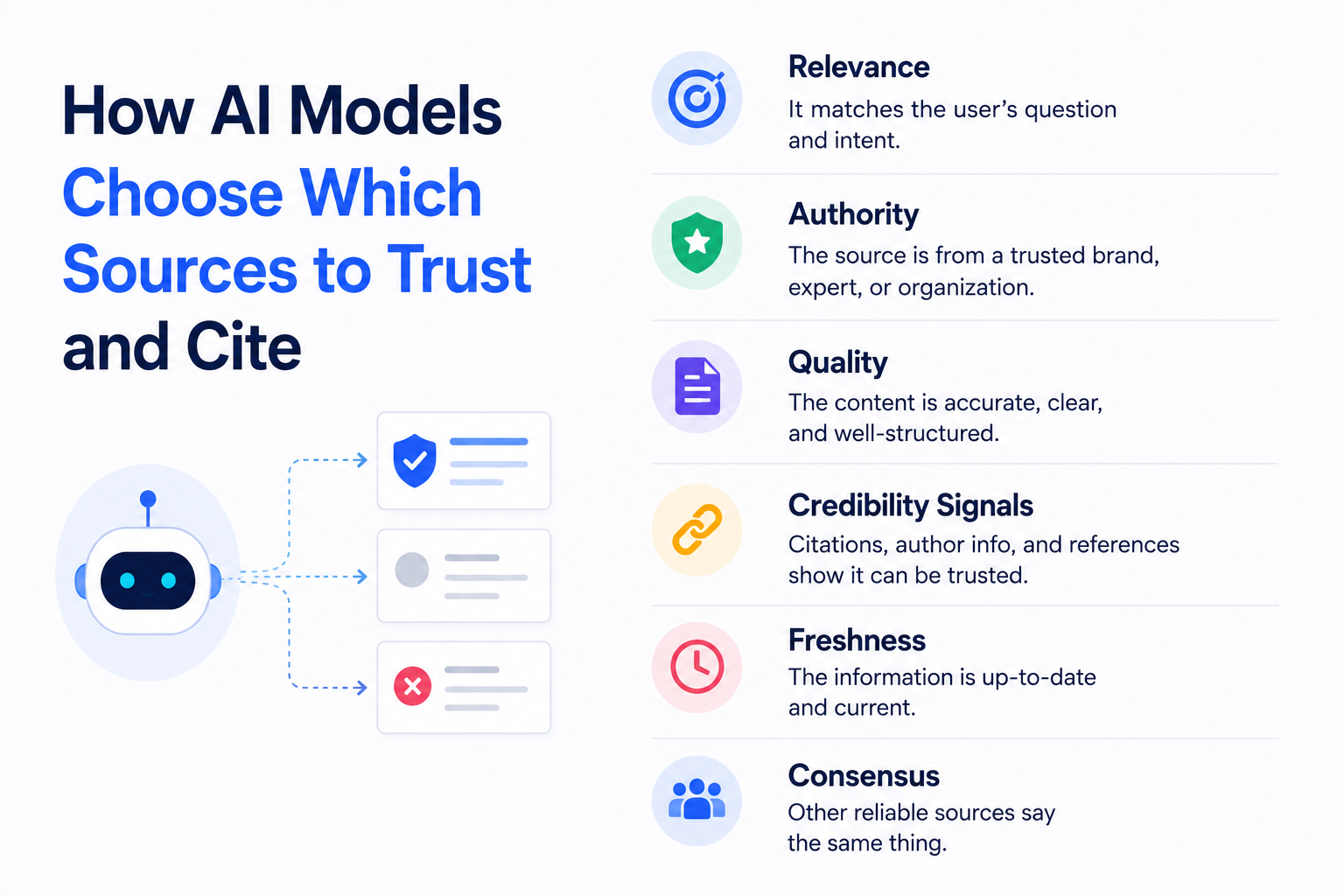
AI models choose which sources to trust and cite by evaluating five core signals: factual density, structural clarity, topical authority, recency, and source reputation—all in fractions of a second.
During training, models absorb patterns from billions of documents, giving more weight to academic papers, government databases, and established publications. At query time, they retrieve with intent, hunting for the exact answer to a specific question rather than crawling blindly.
Yet plenty of accurate pages still get skipped—usually because the answer is buried behind fluff, poorly formatted, or missing context. The good news? These are fixable problems.
The Core Signals AI Models Evaluate
AI models assess sources across five main dimensions:
Factual density. The model scans for concrete claims backed by data. Vague statements get ignored. Specific numbers, dates, and named sources register as credible.
Structural clarity. Semantic HTML matters more than you think. Clear H2 and H3 tags signal logical organization. The model extracts answers faster from well-structured pages.
Answer proximity. How close does your content sit to the user’s question? Direct answers appearing early in the text get pulled more often than buried responses.
Topical breadth. A single post on a topic carries less weight than a site that covers the subject exhaustively. AI models favor sources that demonstrate deep knowledge across connected subtopics.
Recency signals. Outdated content loses fast. Publication dates, recent statistics, and current examples all push your content toward citation.
These signals compound. A page that nails three of five beats one that only nails one.
How Training Data Shapes Source Selection
AI models learn source preferences during training. They ingest billions of documents, each tagged with quality signals. The training process embeds patterns that carry into real-time citation behavior.
Text from academic papers, government databases, and established publications appears consistently in training sets. These formats teach models to recognize authoritative writing. Your content wins citations when it mirrors these patterns without being stiff or academic.
The training data also teaches models what to avoid. Clickbait structures. Thin paragraphs padded with keywords. Pages loaded with ads and popups. These patterns register as low-quality during training and get deprioritized during citation.
You can’t access training data directly. But you can study the output. Ask ChatGPT questions in your niche. Note which sources it cites. Reverse-engineer the patterns. The same qualities appear again and again.
Real-Time Retrieval: What Happens During a Query
When a user asks a question, the AI model triggers retrieval. This process differs from traditional search in one critical way: the model already has context.
Google’s crawler indexes pages blindly. AI models retrieve pages to answer a specific question. They read with intent. They hunt for the exact answer block.
The retrieval pipeline follows this sequence:
- The model interprets the query and identifies the answer type needed—definition, comparison, list, step-by-step guide.
- It searches its indexed sources for content that matches both the topic and the structural format required.
- It ranks candidates based on the signals described above.
- It extracts the most relevant passage, synthesizes it with other sources, and cites accordingly.
Your content needs to survive step two. That means matching the answer format the model expects. A how-to query pulls step-by-step content. A comparison question pulls tables and side-by-side analysis. Format mismatch kills your chances.
Why Some Accurate Pages Still Get Skipped
Plenty of correct content never gets cited. The reasons frustrate site owners but follow consistent logic.
Your answer sits behind fluff. AI scrapers scan for direct responses. If your first 200 words dance around the topic, the model moves on before reaching the good part.
Your formatting hides the answer. Long paragraphs bury key information. The model can’t efficiently extract what it can’t easily find. Break content into scannable chunks.
You lack supporting detail. One-sentence answers rarely get cited alone. Models prefer content that provides the direct answer plus context, examples, or data points.
Competing sources structured better. An equally accurate page with clearer headings and tighter paragraphs wins the citation. Accuracy alone isn’t enough.
Your content contradicts consensus. AI models lean toward consensus views. Going against the grain requires overwhelming evidence. Without it, the model defaults to sources aligned with mainstream understanding.
Practical Steps to Build Citation-Worthy Content
Stop optimizing for bots and start optimizing for extraction. Here’s what moves the needle:
Open with the answer. Write a 40-60 word response to the target question in your first paragraph. Make it self-contained. Make it accurate. The AI can pull this block without needing context from the rest of your page.
Use question-based headings. H2s and H3s that mirror actual queries help models match your content to user intent. “How to reduce churn in SaaS” beats “Churn reduction strategies.”
Add data attribution inline. Don’t say “studies show.” Say “A 2024 McKinsey report found…” Specific attribution builds the factual density models reward.
Create content series. Five interconnected articles on a topic signal depth better than one long post. Internal linking between them reinforces the cluster.
Update visibly. Add “Updated: [date]” near the top. Refresh statistics annually. Models notice recency signals and deprioritize stale content.
Test your content against AI queries. Ask ChatGPT and Perplexity questions your page should answer. If you don’t appear, study the sources that do. Their structure reveals what yours lacks.
FAQ
Do AI models treat all websites equally?
No. But they treat them differently than Google does. A small niche site with precise, well-structured answers can out-cite a major publisher with vague content. Domain authority matters less than answer quality and structure.
How do I know if my content appears in training data versus real-time retrieval?
You can’t distinguish perfectly. But if your content appears in ChatGPT responses for current events questions, that’s real-time retrieval. Training data citations reflect older knowledge cutoffs.
Does social proof affect AI citations?
Indirectly. Highly shared content generates more backlinks and mentions, which increases the chance models encounter your content during training or indexing. Direct social signals don’t factor into citation decisions.
Can AI models detect and ignore AI-written content?
Models don’t explicitly filter AI-written content. But AI-generated text often lacks the factual specificity and unique examples that human-written content provides. Bland, generic content gets skipped regardless of who wrote it.
How often do citations change for the same query?
Frequently. As new content publishes and models update their indexes, citation patterns shift. A source cited today might not appear next week. Consistency in quality keeps you in the rotation.
Should I optimize differently for ChatGPT versus Perplexity versus Google AI Overviews?
The core principles remain the same. Perplexity favors real-time web retrieval more heavily. Google AI Overviews pull from indexed search results. ChatGPT mixes training data with browsing. Strong structure and factual accuracy work across all three.