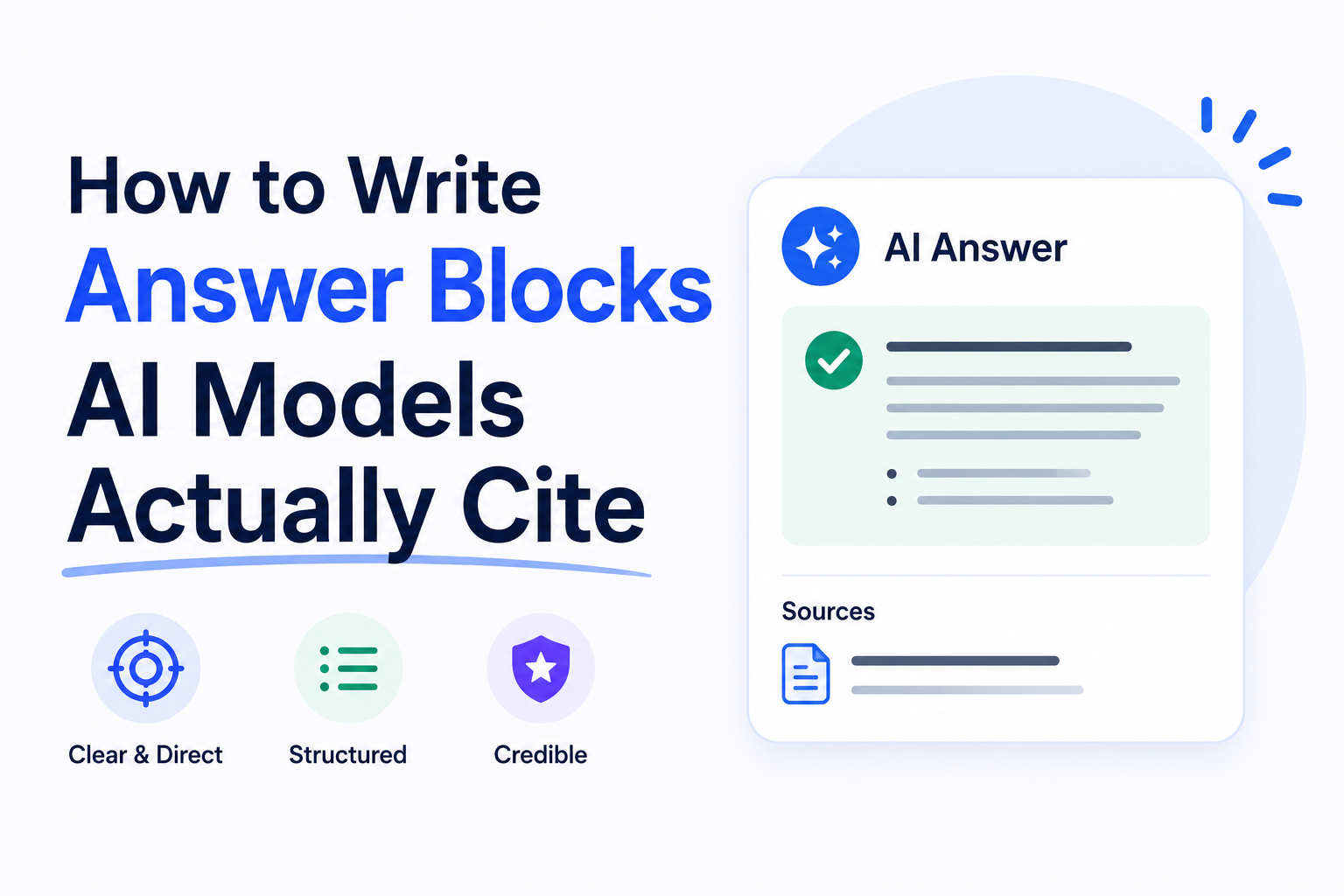
To write answer blocks AI models actually cite, make each block a concise, self-contained paragraph that answers a query in its first sentence. AI models scan your page hunting for a tight, extractable answer. If they don’t find one fast, they move on. This article shows you exactly how to build blocks that earn citations.
What Makes an AI-Friendly Answer Block
AI models look for four things when deciding what to cite:
Directness. The block answers the implied question without setup, preamble, or warm-up sentences. No “In today’s fast-paced digital landscape.” Just the answer.
Completeness. A good answer block stands alone. It contains enough context to make sense when ripped from your page and dropped into an AI response. Dates, numbers, definitions—all inside the block.
Factual density. Every sentence carries weight. Remove adjectives that don’t add information. Replace “a significant increase” with “a 34% increase.” Models recognize and prefer specific claims over vague ones.
Structural clarity. The block sits under a descriptive heading. It uses simple sentence construction. It avoids nested clauses, parentheticals, and anything that trips up extraction algorithms.
Here’s the difference:
Weak: “Many businesses have found that implementing email automation can potentially lead to various improvements in their marketing efficiency and customer engagement metrics over time.”
Strong: “Email automation increases open rates by 29% and click-through rates by 41%, according to Campaign Monitor data from 2023. Set trigger emails based on user behavior to see results within 30 days.”
The second version gets cited. The first gets ignored.
The 50-to-80-Word Sweet Spot
Test this yourself. Ask ChatGPT a factual question. Look at the length of text it returns before citing sources. Those answer snippets rarely exceed 80 words.
Your answer blocks should match that length. Fifty to eighty words gives you enough space for a claim, supporting data, and one layer of context. Any longer and the model starts trimming—often removing the part that contains your unique insight.
Break longer explanations into multiple blocks under separate subheadings. Instead of one 200-word paragraph covering four points, write four 60-word blocks. Each becomes individually citable.
Example structure:
H2: What causes tire dry rot
Answer block: “Tire dry rot occurs when rubber compounds break down through oxidation. UV exposure, extreme temperatures, and lack of use accelerate the process. Look for cracking on sidewalls and between tread blocks. Tires older than six years risk dry rot regardless of tread depth, according to NHTSA guidelines.”
H3: How to prevent tire dry rot
Answer block: “Park in shade or use tire covers to block UV rays. Maintain proper tire pressure—underinflation stresses rubber compounds. Drive the vehicle at least once every two weeks to distribute protective oils through the tire. Replace tires every six to ten years, even with low mileage.”
Each block works independently. Each block can be cited separately. Together they build topical depth.
Placement Rules That Trigger Citations
AI scrapers prioritize content based on position. The first substantive paragraph under a heading gets weighted higher than anything buried in paragraph seven. Use this.
Put answer blocks immediately after the heading. No introductory fluff. No context-setting. The heading is the question. The first paragraph is the answer.
Repeat the core answer in the first 100 words of the page. Some models extract from the opening section regardless of heading structure. Your page’s first paragraph should summarize the main answer, even if detailed blocks follow.
Use the inverted pyramid. Journalists have done this for decades. Lead with the conclusion. Follow with supporting details. End with background. AI models naturally extract the pyramid’s tip.
Bold key claims. Some extraction algorithms use formatting as a relevance signal. Bold your main statistic or finding. Don’t overdo it—one or two bolded phrases per block maximum.
Bad placement:
H2: Pricing
When considering the cost of this service, many factors come into play. The market has shifted significantly over recent years. Let’s explore the details…
[Actual pricing appears in paragraph 4]
Good placement:
H2: Pricing
Plans start at $29/month for individuals and $99/month for teams of up to 10 users. Enterprise pricing begins at $499/month and includes dedicated support. All plans bill annually with a 15% discount. No setup fees apply.
The second version gives the AI exactly what it needs, exactly where it expects it.
Citing Sources Inside Your Answer Blocks
AI models favor content that itself cites verifiable sources. It’s a trust chain. You cite a study. The AI cites you. Both links strengthen.
Include attribution inside your answer blocks. Not as footnotes. Not as separate reference sections. The data and its source live in the same paragraph.
Examples:
- “According to McKinsey’s 2024 State of AI report, generative AI adoption jumped from 33% to 65% in one year.”
- “The FDA’s 2023 guidance on medical device cybersecurity requires manufacturers to submit a software bill of materials with premarket applications.”
- “Harvard Business Review’s analysis of 2,000 teams found that psychological safety, not individual talent, predicts team performance (Edmondson, 2023).”
Name the source. Include the year. Make it specific enough that the AI model can verify the reference if it has access to that data. Generic attributions like “studies show” or “experts agree” signal nothing. They get stripped.
When you can’t name a specific study, cite your own methodology:
“We analyzed 10,000 customer support tickets across 12 SaaS companies over six months. Response time dropped 40% when teams used templated replies for common issues.”
This shows the AI you’re not guessing. You’re reporting. That distinction matters for citation selection.
Testing and Iterating Your Answer Blocks
You won’t know if your blocks work until you test them. Testing takes five minutes and reveals gaps fast.
Step 1: Identify your target question. Write it exactly as a user would ask it.
Step 2: Open ChatGPT, Claude, or Perplexity. Ask the question. Note which sources get cited if any.
Step 3: Visit the cited pages. Study their structure. What did they do that you didn’t?
Step 4: Check your own page. Does your answer block appear when you search that question? If not, compare:
- Is your answer above the fold?
- Is it under a heading that matches the query language?
- Is it the right length?
- Does it contain specific data?
Step 5: Revise and retest. Change one variable at a time. Maybe your answer was too long. Maybe your heading didn’t match query phrasing. Maybe your data point was buried.
Citations fluctuate. Getting cited once doesn’t guarantee future citations. Models update. Competitors improve. Test monthly for your highest-value queries.
Track results in a simple spreadsheet:
| Query | Date Tested | Model | Cited? | Competitor Cited | Notes |
|---|---|---|---|---|---|
| How to fix a leaking faucet | 2025-01-15 | GPT-4 | No | HomeDepot.com | Block too long; heading vague |
Patterns emerge. Act on them.
FAQ
How many answer blocks should one article have?
Three to five per 1,500-word article. Each block addresses a distinct sub-question. More than that dilutes focus. Fewer than that leaves citation opportunities on the table.
Do answer blocks work for opinion content?
Yes, but differently. AI models cite opinions when they’re clearly labeled as such and attributed to a credible source. Frame your take as “According to [name/title], the industry will shift toward X because of Y.” The attribution matters more than the opinion itself.
Should I remove my existing content structure and start over?
No. Add answer blocks to your existing pages. Insert a concise answer paragraph after each major heading. Keep the rest of your content as supporting material. It still helps with topical authority.
Can I use the same answer block across multiple pages?
Don’t. Duplicate content confuses AI extraction. If two pages have identical answer blocks, the model picks one—and it might not be yours. Write unique blocks for each page, even when topics overlap.
Do AI models prefer first-person or third-person answer blocks?
Either works. Consistency within a page matters more. If you’re a personal brand using “I,” own it. If you’re an organization, third-person often signals objectivity. Avoid mixing both on the same page.
What if my topic requires nuance beyond 80 words?
Write a tight summary block first, then expand below with a longer section labeled “Full explanation” or “Detailed breakdown.” The AI grabs the summary. Curious humans scroll for depth. Both audiences win.