Introduction
You open Google Analytics. The numbers drop. Organic traffic slides month over month. But your content ranks fine. Your keywords hold position. What gives?
The answer hides in plain sight. Users get answers without clicking. AI Overviews, ChatGPT, Perplexity, Claude—they scrape your content, synthesize it, and deliver answers directly. Zero clicks. Zero visits. Your analytics dashboard shows failure. Reality tells a different story.
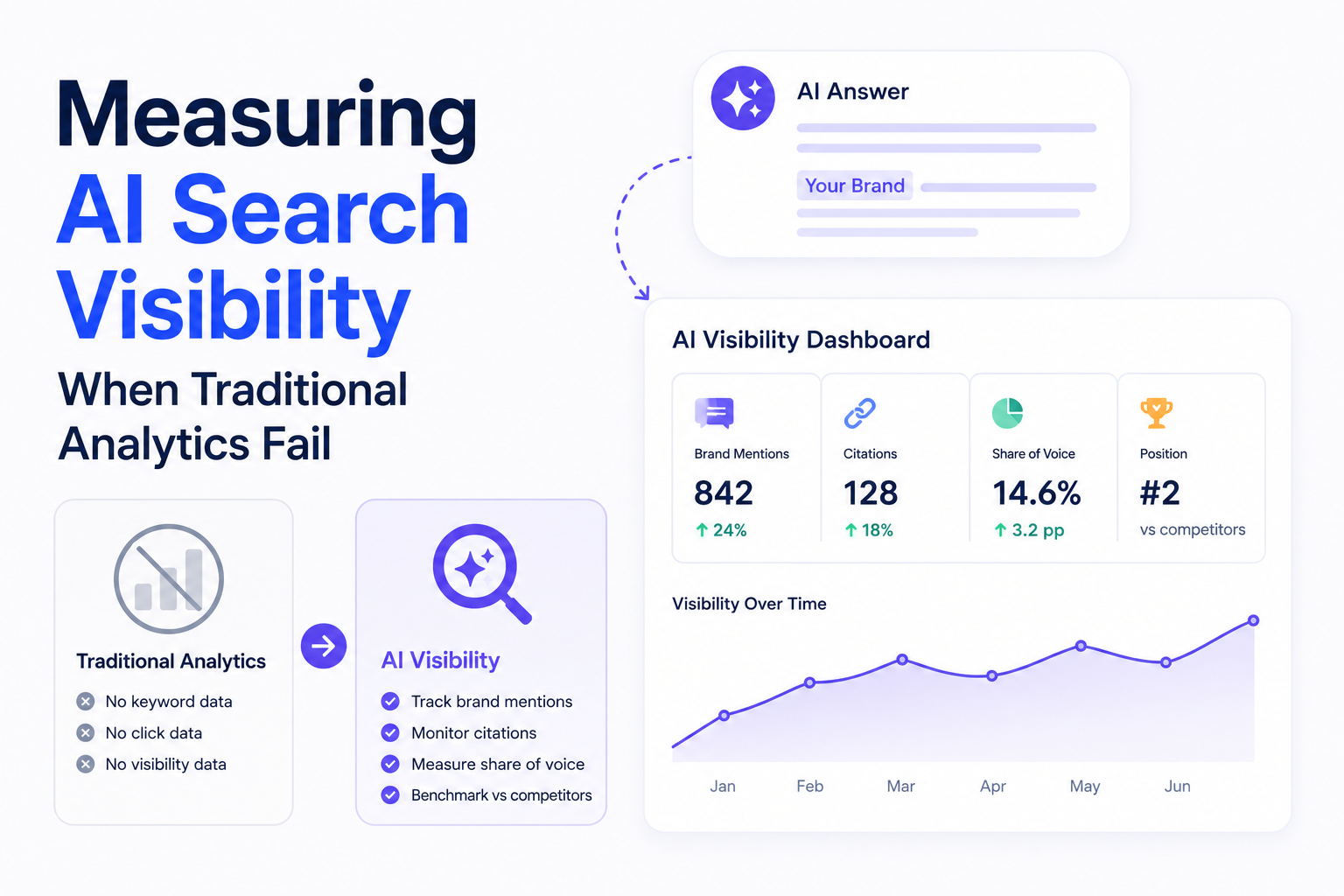
Traditional analytics tools measure clicks and pageviews. AI search visibility happens before the click—often without any click at all. You need new metrics, new methods, and a new mindset to track what matters now.
The Zero-Click Reality
Google’s AI Overviews now appear in roughly 30% of search results. ChatGPT surpassed 200 million weekly active users. Perplexity processes millions of queries daily. Each query pulls information from sources like yours and displays answers without sending visitors your way.
Think about what happens. A user asks “how to fix a leaking pipe.” The AI reads your plumbing guide, extracts the steps, and presents them in a neat list. The user gets their answer. They never visit your site. Your analytics register nothing.
This isn’t a bug. It’s the design. AI search engines aim to keep users in-platform. Your visibility shifted from “getting clicks” to “getting cited.” Your analytics never got the memo.
Zero-click searches now account for roughly 25-30% of all queries across major platforms. That percentage grows. Your traffic decline may actually signal increased visibility—just visibility your tools can’t measure.
Metrics That Actually Matter Now
Stop staring at pageviews. Start tracking these:
Citation frequency. How often do AI models reference your brand or content in responses? Count it. Track it weekly. Note which pages get cited and which don’t.
Share of AI voice. For your target topics, what percentage of AI responses include your content versus competitors? This mirrors traditional share-of-search but applies to generative answers.
Brand mention context. When AI models cite you, what do they say? Positive framing? Neutral attribution? Do they position you as an authority or just one of many sources?
AI referral traffic. Small but growing. Look for traffic from perplexity.ai, chatgpt.com, claude.ai, and similar domains in your analytics. Label these as AI-referred visitors.
Query coverage. How many questions in your topic space does your content address inside AI answers? Map your presence across question variations.
Conversion from AI visitors. These users arrive informed. They read AI summaries of your content before clicking. They convert differently. Track them separately.
Old metrics measure the funnel from impression to click. New metrics measure the funnel from crawl to citation to eventual engagement.
Manual Tracking Methods That Work Today
No perfect AI visibility tool exists yet. You build your own tracking process.
Run weekly query tests. Pick 20-30 questions your content should answer. Ask ChatGPT, Perplexity, Claude, and Google’s AI Overview. Record which sources each platform cites. Note your presence or absence. Log results in a spreadsheet.
Set up citation alerts. Use brand monitoring tools like Mention or Google Alerts. Watch for your brand name appearing alongside AI-related terms. This catches citations you might miss.
Query your own content. Feed your articles into AI platforms and ask what questions they answer. Compare the AI’s extraction against what you intended. Identify gaps where the AI misses your key points.
Monitor competitor citations. Run the same queries tracking competitors. Who gets cited more? What content types earn citations? Reverse-engineer their success.
Build a dashboard. Track these manually for now:
| Metric | How to Measure | Frequency |
|---|---|---|
| Citation presence | Manual query testing | Weekly |
| Share of AI voice | Competitive citation comparison | Monthly |
| AI referral traffic | Analytics source/medium reports | Weekly |
| Brand sentiment in AI | Qualitative review of citations | Monthly |
| New query coverage | Gap analysis against search trends | Monthly |
This takes time. It beats flying blind.
Technical Signals AI Models Reward
Your content gets cited for specific, observable reasons. Understanding these helps you predict and improve visibility.
Direct answer proximity. AI scrapers prioritize pages that place clear answers near the top. If your first 100 words answer the question directly, your citation odds increase.
Schema markup matters less, structure matters more. Traditional SEO loves schema. GEO rewards clean HTML hierarchy. Use proper heading tags. Break content into logical sections. AI parsers extract meaning from structure.
Source freshness signals. AI models favor recently updated content with visible dates. Show publication dates. Show last-updated timestamps. Stale content loses citations even if it’s accurate.
Attribution density. Pages that cite their own sources get cited more often. Link to studies. Reference data. Show your work. AI models trust content built on verifiable foundations.
Entity clarity. AI systems understand entities—people, places, products, concepts. Make yours unambiguous. Use full names before abbreviations. Define terms. Connect related entities explicitly.
Test these signals. Update a page. Wait two weeks. Query again. Notice what changed.
Connecting Visibility to Business Results
Citations feel abstract until you connect them to revenue.
Track AI-referred conversions separately. Create a custom segment in your analytics for visitors from AI platforms. Compare their behavior against organic search visitors. AI-referred users often show higher intent because they already consumed your answer before clicking.
Attribute assisted conversions. A user sees your brand cited in Perplexity. They don’t click. Days later they search your brand directly and convert. Your analytics credit the brand search. The AI citation drove the whole chain.
Survey your customers. Ask new customers where they first heard about you. Include generative AI as an option. This catches visibility your analytics miss entirely.
Map citation growth against revenue trends. When AI citations increase, does brand search lift? Does direct traffic grow? These downstream effects signal real impact.
Build a narrative: “AI cited our content in 340 responses this month. Brand search rose 12%. AI referral traffic converted at 4.2%. Our estimated AI-driven revenue: $X.” That narrative matters to stakeholders more than any ranking report.
FAQ
Why does my traffic drop when rankings stay the same?
AI answer boxes and overviews satisfy user queries without clicks. Your content still gets seen but through AI extraction rather than direct visits. Your visibility shifted platforms, not disappeared.
Can I track AI citations automatically?
Limited automation exists today. Tools emerge but none capture the full picture. Manual query testing remains most reliable. Some SEO platforms now include AI visibility features. Check your current tools for updates.
How fast do content updates affect AI citations?
Variable. Some platforms reindex quickly. Others take weeks. Test systematically. Update content. Wait 14 days. Query platforms. Record changes. Patterns emerge over time.
Do all AI platforms cite sources equally?
No. Perplexity consistently displays sources. ChatGPT cites more in paid tiers. Claude varies by query type. Google AI Overviews link prominently. Track each platform separately.
What if I never get cited?
Start with answer formatting. Place a 50-80 word direct answer at the top of each page. Cite your own sources. Build topic clusters. Citations follow content designed for extraction.
Should I block AI crawlers to protect traffic?
You can. Some publishers do. But AI search grows regardless. Blocking crawlers removes you from citation entirely. Competitors fill the gap. Visibility drops to zero, not just clicks.
Key Takeaways
- Traditional analytics measure clicks. AI visibility happens before and without clicks. You measure different things now.
- Track citations, share of AI voice, AI referral traffic, and brand mentions inside generative platforms.
- Manual query testing works today. Automated tools catch up. Don’t wait for perfect tools.
- Structure your content for AI extraction. Direct answers, clear headings, source attribution, and freshness signals all increase citation rates.
- Connect AI visibility to revenue through referral tracking, conversion attribution, and customer surveys.
- Traffic drops don’t always signal failure. Check AI platforms first before panicking about rankings.