Introduction
You publish a perfect article. It ranks number one. Nobody clicks it. Welcome to the zero-click reality.
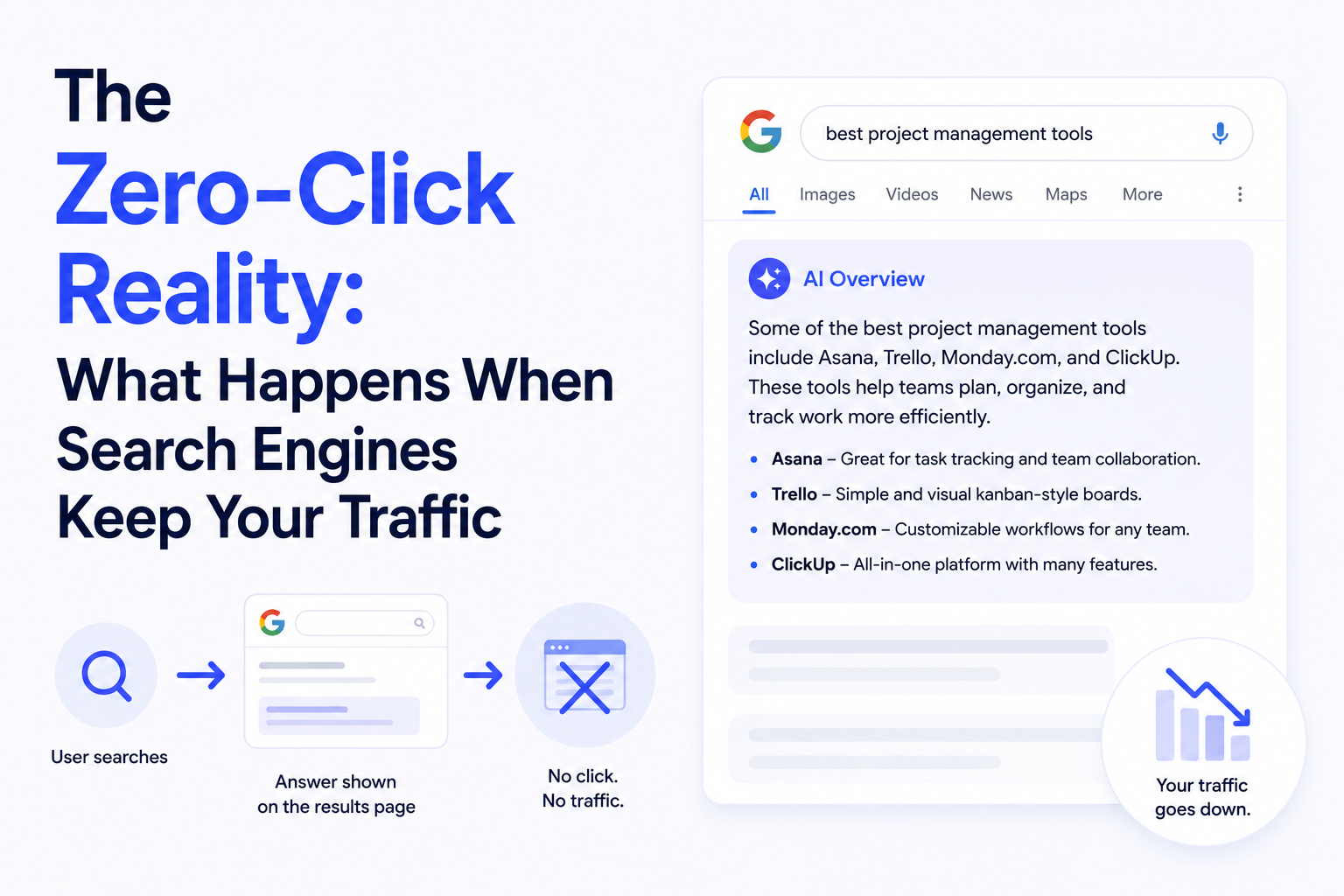
Google keeps changing the deal. Users type a question and get the answer right on the search results page. No website visit required. 25% of all searches now end without a click. In some industries, that number crosses 50%.
This isn’t a bug in the system. It’s the system working exactly as designed. And it changes everything about how you think about visibility, traffic, and content strategy. The old playbook said: rank high, get clicks. The new playbook says: get cited, get seen, even when nobody visits your site.
What Zero-Click Means in Practice
A zero-click search happens when Google answers the query without the user leaving the results page. Featured snippets, knowledge panels, maps packs, and AI Overviews all deliver answers on the spot.
Here’s what that looks like:
- Someone searches “how long to boil eggs” and sees a 10-minute answer at the top. No click.
- A user asks “current temperature in Austin” and gets it from the weather panel. Done.
- A searcher types “Tesla stock price” and the ticker displays instantly. Session over.
These aren’t edge cases. They’re the default experience for millions of queries. Google scrapes your content, extracts the answer, and serves it to the user. You did the work. Google got the session. The user got satisfied. You got an impression without a visit.
The traffic leak isn’t theoretical. SparkToro’s 2023 research shows that for every 1,000 Google searches in the US, only 360 result in a click to the open web. The rest stay inside Google’s ecosystem.
The Industries Getting Hit Hardest
Zero-click doesn’t strike evenly. Some niches bleed traffic while others stay relatively stable.
Hardest hit:
- Weather forecasts. Nobody clicks. The answer sits right there.
- Dictionary definitions. Google pulls from Merriam-Webster or Oxford directly.
- Simple math and calculations. The calculator widget handles it.
- Basic how-to questions. “How to tie a tie” gets a step-by-step snippet.
- Celebrity ages and heights. Knowledge panels own these.
- Stock prices and currency conversions. Instant widgets everywhere.
Moderately affected:
- Recipes. Users click when they want more than ingredients.
- Health information. AI Overviews summarize but serious searchers still visit sources.
- Product comparisons. Featured snippets summarize but buying decisions demand deeper reading.
Least affected (for now):
- Complex B2B topics. No snippet captures enterprise software evaluation.
- Opinion pieces and analysis. AI struggles to synthesize genuine perspective.
- Local services requiring booking. The click becomes the conversion path.
Check your analytics. Filter for informational queries that drive organic traffic. Then search those terms yourself. If Google already answers them on the SERP, expect those clicks to shrink.
Featured Snippets: The Original Traffic Killer
Featured snippets launched in 2014. They pulled a paragraph from a ranking page and displayed it above the blue links. SEOs celebrated. Position zero. Ultimate visibility. Then the data arrived.
Getting the featured snippet often reduces click-through rate. Users read the extracted answer and leave. You traded clicks for brand exposure. That trade sometimes makes sense. Sometimes it doesn’t.
Ahrefs studied 2 million featured snippets. Pages that won the snippet saw click-through rates drop compared to their previous position, even when they also ranked number one organically. The snippet cannibalizes the click.
The mechanic works simply: Google extracts your answer, displays it, attributes it with a tiny link, and satisfies the user. Most searchers don’t scroll further. They got what they needed.
But here’s the twist. If you don’t win the snippet, someone else does. And their brand gets the attribution while you get neither the click nor the exposure. You compete in a system where the best-case scenario is having your content displayed without a visit. The worst case is having neither.
AI Overviews: The Accelerant
Google rolled out AI Overviews in 2024. The impact on clicks dwarfs featured snippets. These AI-generated summaries synthesize information from multiple sources and present a comprehensive answer at the top of results.
A user searches “best way to clean a cast iron skillet.” The AI Overview delivers a multi-paragraph answer covering salt scrubbing, oil seasoning, and common mistakes, all stitched from multiple websites. Below that, traditional results sit ignored.
The AI Overview cites sources with small link icons. Early data suggests these links get clicked at lower rates than traditional organic results. The synthesis satisfies the query before the user reaches individual pages.
This changes the value proposition of ranking. You no longer fight for clicks. You fight for citations. Your content becomes raw material for Google’s answer engine. You contribute value. Google captures the attention.
Some publishers report AI Overview traffic actually increases clicks when their content is cited as the primary source for complex queries. But for simple informational queries, the Overview absorbs the intent entirely.
How to Adapt Your Content Strategy
You can’t fight the zero-click trend. You can adapt to it. Here’s what works:
Write for extraction. Structure answers so AI models grab your content. Place concise, direct answers in the first paragraph. Use clear definitions. State facts without hedging. If Google or ChatGPT needs a definition, make yours the one they pull.
Create content AI can’t replicate. AI struggles with original research, firsthand experience, strong opinions, and data you collected yourself. Publish survey results. Share case studies with actual numbers. Write from direct experience. The AI can summarize your findings but users who want the full picture will click.
Layer your content. Give the extractable answer at the top, then add depth below. The snippet satisfies the quick query. The deeper content captures the engaged user. Both serve different intents from the same page.
Track citation visibility, not just rankings. Use branded search monitoring. Set up alerts for your brand name alongside AI platforms. Check if ChatGPT, Perplexity, and Google AI Overviews cite you for queries in your space. This becomes your new SERP.
Build brand recognition inside answer boxes. When Google pulls your content into a snippet or AI Overview, the attribution matters. Users remember sources that appear consistently. That recognition drives direct traffic and branded searches later, even if the immediate click doesn’t happen.
FAQ: The Zero-Click Reality
Should I block Google from showing my content in snippets?
You can. Use the nosnippet tag. But this removes you from all featured snippets and AI Overviews. Your competitors get the visibility you surrendered. Most sites lose more than they gain.
Does zero-click affect mobile and desktop differently?
Yes. Mobile searches show higher zero-click rates because screen space limits scrolling. The answer fills the viewport. Desktop users see more results and click more often.
How do I measure zero-click impact on my site?
Check Google Search Console. Filter for queries with high impressions and low click-through rates. Cross-reference those queries against the SERP to see if featured snippets or AI Overviews appear. That’s your zero-click gap.
Will AI Overviews replace featured snippets entirely?
Google is integrating both. AI Overviews handle complex, multi-step queries. Featured snippets remain for simple definitions and facts. Both reduce clicks in different ways.
Can I optimize specifically for AI Overview citations?
Yes. Use clear H2s and H3s. Write direct answers in 40-60 word paragraphs. Include credible sources and statistics. Structure content logically. These signals help AI models select your content for synthesis.
Does zero-click mean SEO is dying?
No. It means SEO is transforming. Visibility now includes appearing inside AI-generated answers and featured snippets, not just ranking in blue links. The game expands. It doesn’t end.
What’s the conversion path when nobody visits your site?
Brand recall and direct traffic. Users exposed to your brand in snippets and AI answers search for you later when they have higher-intent needs. The attribution builds familiarity. That familiarity converts over time.