Introduction
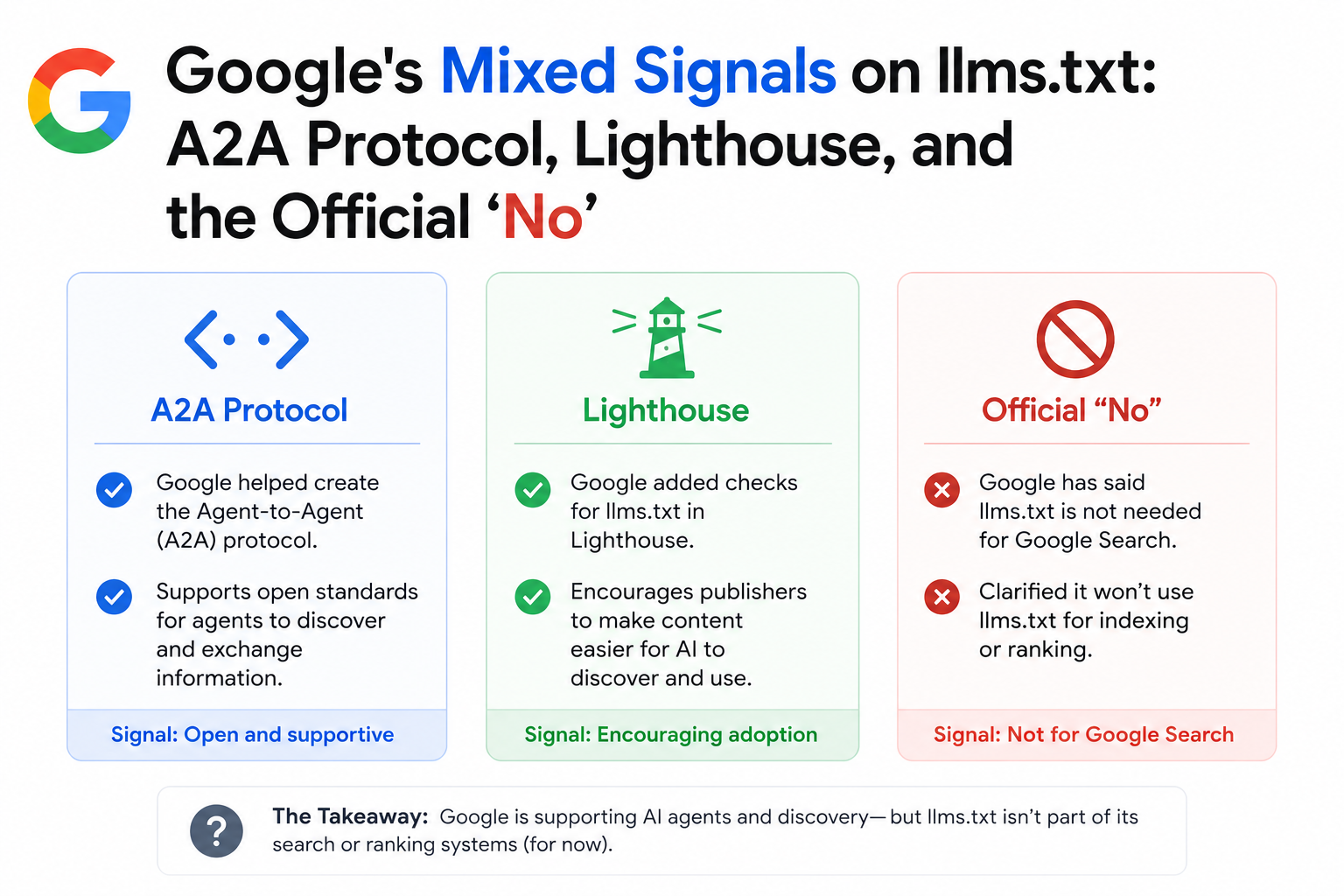
Google’s position on llms.txt is a study in contradiction. On one hand, Gary Illyes told the world Google has “no plans to support LLMs.txt.” John Mueller compared it to the keywords meta tag on Reddit—the SEO equivalent of calling something a relic. On the other hand, Google included llms.txt in its Agent-to-Agent (A2A) protocol by May 2026, built llms.txt files for Gemini, Chrome, Firebase, and Flutter, and folded it into Lighthouse audits. You can’t blame anyone for being confused. This article unpacks exactly what Google has said, what it has done, and how to interpret the gap between the two.
The Official Line: ‘No Plans to Support It’
Gary Illyes didn’t hedge. He stated flatly that Google has no intention of supporting llms.txt. John Mueller went further, invoking the keywords meta tag—a feature webmasters embraced for years while search engines ignored it completely. The implication was clear: llms.txt could follow the same path, a file enthusiastically adopted by website owners but ultimately irrelevant to the systems it was built for.
Google’s official rationale hasn’t been spelled out in detail, but reading between the lines gives you three likely reasons:
Google already processes full HTML. Google’s crawler infrastructure is built to parse entire pages—JavaScript, DOM, layout, the works. It doesn’t need a stripped-down Markdown summary because it already extracts structured data from the real thing. Adding llms.txt support would mean maintaining a parallel ingestion pipeline, which introduces maintenance overhead with no clear payoff.
Curated summaries raise trust questions. A site owner writing their own llms.txt gets to decide what’s important. That’s the point. But from a search engine’s perspective, self-curated content introduces a new vector for manipulation. Google’s systems are designed to evaluate pages holistically, not to take a publisher’s word for what matters.
No formal standard exists. llms.txt is a community proposal, not an IETF or W3C standard. Google rarely builds production dependencies around unofficial specs. Supporting something pre-standardization creates a commitment that’s hard to unwind if the spec changes direction.
That’s the stated position. But stated positions don’t always match institutional behavior.
A2A Protocol: llms.txt Gets a Seat at the Table
In May 2026, Google published its Agent-to-Agent (A2A) protocol—a framework for AI agents to communicate and collaborate across platforms. Tucked into that specification was a reference to llms.txt as one mechanism agents could use to discover and understand each other’s capabilities.
This wasn’t a throwaway mention. A2A is Google’s vision for how autonomous AI agents will interoperate in the future. Including llms.txt in that vision signals something the official statements don’t: Google’s engineering teams see value in the concept, even if the search team hasn’t adopted it.
The A2A reference matters because it comes from a different part of Google than Illyes and Mueller. Search engineers optimize for crawling, indexing, and ranking. Protocol engineers optimize for agent interoperability. Two different teams, two different use cases, two different conclusions about the same file format.
This internal tension isn’t unusual at Google. The company famously maintained separate social strategies across YouTube, Google+, and Blogger for years. What’s notable here is the public dissonance—one team publicly dismissing a standard while another team publicly adopts it.
Lighthouse Audit: Baking llms.txt Into Developer Workflows
Google Lighthouse, the automated auditing tool used by millions of developers to assess website quality, now includes an llms.txt audit. If your domain lacks an llms.txt file, Lighthouse flags it.
This is a concrete action with real downstream effects. Lighthouse scores influence developer priorities. A flagged audit nudges teams—especially documentation-heavy products—to create llms.txt files. Multiply that across Lighthouse’s user base and you get thousands of new llms.txt implementations driven directly by Google tooling.
Consider the contradiction: Google’s webmaster relations team says llms.txt doesn’t matter. Google’s developer tooling team tells you your site is incomplete without it. Which signal do you follow?
Lighthouse’s inclusion of llms.txt makes pragmatic sense regardless of the search team’s position. The audit suite evaluates best practices across performance, accessibility, SEO, and now AI-readiness. Even if Google Search never touches llms.txt, other AI systems might. Lighthouse is simply reflecting that possibility back to developers.
But the optics are messy. When your own auditing tool treats a file format as important enough to check for, calling it the next keywords meta tag rings hollow.
Google’s Own llms.txt Files: Actions Speak Louder
Google doesn’t just audit for llms.txt. It publishes them. Multiple Google properties ship llms.txt files today:
- Gemini Developer API docs include a maintained llms.txt pointing to key endpoints, authentication guides, and SDK references.
- Chrome Developer Documentation uses llms.txt to structure its sprawling docs set for AI consumption.
- Firebase and Flutter documentation both ship llms.txt files, giving LLMs curated entry points to Google’s own developer ecosystem.
These aren’t experiments. They’re live files, publicly accessible, maintained alongside Google’s production documentation. The Gemini API docs even follow the spec’s recommendation to provide Markdown versions of HTML pages at parallel URLs.
You have to ask: if llms.txt is a futile gesture, why is Google doing it for its own most important developer properties? The answer likely comes down to internal pragmatism. Individual product teams at Google—especially those serving developers who might use Claude, Cursor, or other AI tools—recognize that llms.txt costs almost nothing and might help their content surface in AI responses. They’re not waiting for corporate alignment. They’re shipping.
What This Means for You
Google’s mixed signals create a straightforward decision matrix for site owners. The search team’s dismissal means you shouldn’t expect llms.txt to influence your Google rankings or your visibility in AI Overviews. That door appears firmly closed for now.
But A2A protocol inclusion and Lighthouse auditing suggest something different: llms.txt has internal champions at Google who see a future where it matters, even if that future isn’t Search. When protocol teams and developer tooling teams both endorse a format, it has institutional momentum that outlasts any single VP’s stance.
Here’s the practical takeaway: build your llms.txt file. Google’s own product teams do it. Lighthouse tells you to do it. It takes 20 to 60 minutes. But calibrate your expectations. You’re not building a Google ranking signal. You’re building infrastructure for an AI ecosystem where Google Search is one player among many. Claude, Perplexity, ChatGPT, coding assistants—these systems may eventually consume llms.txt regardless of what Google’s search division decides.
The tension between Google’s words and actions is a feature of the transition we’re living through. Old guard teams optimize for the web as it was. New guard teams build for the web as it’s becoming. llms.txt sits right at that fault line, and Google’s mixed signals are just the tremors.
FAQ
Did Google officially endorse llms.txt?
No. Google’s search leadership has publicly stated they have no plans to support llms.txt. However, Google has included llms.txt in its A2A protocol, Lighthouse audits, and publishes llms.txt files for several of its own developer documentation properties.
Will creating an llms.txt file help my Google rankings?
There is zero evidence that Google uses llms.txt as a ranking signal. John Mueller’s comparison to the keywords meta tag strongly suggests Google Search does not and will not consume llms.txt for ranking purposes.
Why does Google publish llms.txt files if it says it won’t support them?
Different teams make different decisions. Product teams managing developer documentation likely want their content accessible to non-Google AI systems like Claude, Cursor, and Perplexity. Publishing llms.txt costs nothing and keeps their docs AI-ready regardless of corporate search policy.
What’s the A2A protocol and why does llms.txt matter there?
The Agent-to-Agent protocol is Google’s framework for enabling autonomous AI agents to discover, communicate, and collaborate. llms.txt appears in the spec as a discovery mechanism agents can use to understand what capabilities other agents offer. This use case is separate from search indexing and ranking.
Should I prioritize the Lighthouse llms.txt audit?
If Lighthouse flags your site for missing llms.txt, creating one is a fast fix that improves your audit score. But don’t treat it as urgent—Lighthouse audits cover dozens of checks, and llms.txt is among the lowest-impact items for actual user experience or search performance.
Sources
- llmstxt.org — The official /llms.txt file specification
- Google A2A Protocol announcement (May 2026)
- SE Ranking — LLMs.txt: Why Brands Rely On It and Why It Doesn’t Work
- Index Lab — LLMs.txt: Does It Actually Work? (Updated October 2025)
- Limy.ai — LLMs.txt in 2026: The Full Guide
- Google Lighthouse documentation
- Gemini Developer API llms.txt